
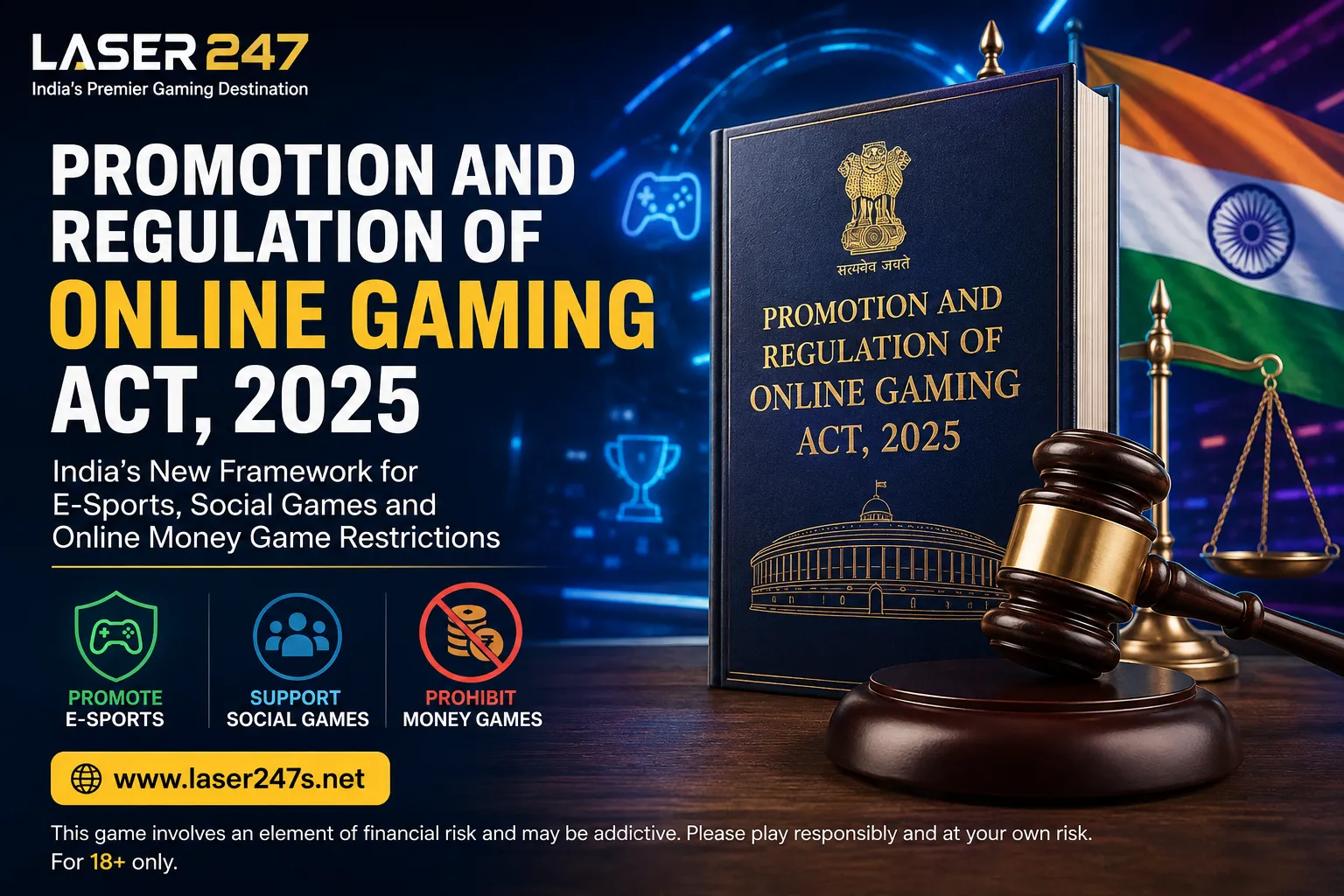
A Complete Guide to India’s New Online Gaming Law
The Promotion and Regulation of Online Gaming Act, 2025 represents a major change in the way online gaming is governed in India. The legislation was enacted on 22 August 2025 as Act No. 32 of 2025 and introduced a nationwide framework covering e-sports, online social games and online money games.
Unlike a traditional regulatory model that simply licenses different forms of real-money gaming, the Act takes a much stricter approach toward online money games. At the same time, it seeks to encourage the development of e-sports and online social gaming as legitimate parts of India’s digital economy.
The law is therefore important not only for gaming companies and players, but also for advertisers, payment providers, technology platforms and businesses involved in India’s rapidly growing digital entertainment sector.
What Is the Promotion and Regulation of Online Gaming Act, 2025?
The Promotion and Regulation of Online Gaming Act, 2025 is a central Indian law designed to create a legal framework for different categories of online games.
The Act broadly establishes three important areas:
- Recognition and promotion of e-sports
- Recognition and development of online social games
- Prohibition of online money games and related services
The legislation applies throughout India and also covers online money gaming services offered within India or operated from outside India.
This makes the law particularly significant for offshore gaming websites and applications that attempt to offer money-based games to users located in India.
Explore: Laser247 | Laser 247 | Laser247.com | Laser247 ID | Laser 247 ID | Laser247 Login | Laser247 Club | Responsible Gaming
Why Was the New Online Gaming Law Introduced?
India’s online gaming industry has expanded rapidly, with millions of people using mobile and internet-based gaming platforms.
Alongside the growth of the sector, concerns emerged around:
- Financial losses among users
- Gaming addiction
- Fraudulent platforms
- Misuse of payment systems
- Money laundering
- Aggressive advertising
- Protection of younger users
- Cross-border online gaming operations
The government has stated that the new framework is intended to create a safer and more accountable digital gaming environment while encouraging legitimate gaming sectors such as e-sports and social games.
The legislation therefore distinguishes between gaming as entertainment or competitive sport and gaming that involves monetary stakes or financial rewards.
What Is an Online Money Game?
One of the most important aspects of the Act is its treatment of online money games.
The law prohibits online money games regardless of whether the underlying game is based on:
- Skill
- Chance
- A combination of skill and chance
This is an important departure from earlier debates around whether particular real-money games should be classified as games of skill or games of chance. Under the new legislation, the presence of a monetary stake and the possibility of winning money are central to the prohibition.
As a result, businesses cannot assume that describing a particular game as “skill-based” automatically places it outside the scope of the Act.
Key Provisions of the Act
The Act contains several important provisions that affect different parts of the online gaming ecosystem.
1. Promotion of E-Sports
The legislation recognises e-sports as an important area of online gaming.
Competitive gaming involving organised events, players or teams can fall within the e-sports framework where the statutory requirements are satisfied.
The objective is to support the development of competitive gaming, tournaments, professional players and the wider e-sports ecosystem.
This could contribute to opportunities in:
- Professional gaming
- Gaming tournaments
- Coaching
- Streaming
- Game development
- Event management
- E-sports infrastructure
The government’s approach is therefore not a blanket prohibition on online gaming.
Instead, the law attempts to separate legitimate competitive and recreational gaming from money-based gaming.
2. Development of Online Social Games
The Act also provides for recognition and development of online social games.
Social games generally focus on entertainment, interaction and participation rather than monetary wagering.
This category can include games where players participate for enjoyment, social interaction or achievement without staking money to win monetary returns.
The recognition of this category creates an opportunity for developers to build gaming products that do not rely on real-money wagering.
3. Prohibition of Online Money Games
Section 5 of the Act specifically deals with the prohibition of online money games and online money gaming services.
The prohibition is one of the defining features of the legislation.
This means businesses cannot legally operate an online service that falls within the statutory definition of an online money game.
The restriction also extends beyond simply offering the game itself.
4. Restrictions on Advertising
The Act also prohibits advertising related to online money games.
This is particularly significant for digital marketing agencies, publishers, influencers, broadcasters and advertising networks.
A business cannot simply move its operations to another channel and continue promoting a prohibited online money gaming service.
The government’s stated position is that advertising and promotion of prohibited online money games are also restricted.
5. Restrictions on Financial Transactions
Another major provision concerns the transfer and processing of funds associated with prohibited online money gaming services.
Section 7 addresses the transfer of funds in connection with online money games.
This means the legislation is not limited to gaming operators.
Payment systems and financial intermediaries can also be affected when transactions are connected with prohibited online money gaming activities.
This provision is intended to make it more difficult for prohibited platforms to continue operating through conventional payment channels.
Online Gaming Authority of India
The Act provides for the establishment of an Authority on Online Gaming.
The Authority is intended to provide an institutional framework for administering the legislation.
The government subsequently issued a notification concerning the constitution of the Online Gaming Authority of India (OGAI) on 22 April 2026.
The creation of a dedicated authority is important because online games can differ significantly in their mechanics, monetisation models and technological structures.
A specialised authority can help determine how different gaming services should be treated under the legal framework.
Powers of the Government and Authorities
The Act provides authorities with several enforcement powers.
These include mechanisms relating to:
- Investigation of offences
- Search and seizure
- Directions for compliance
- Blocking of online money gaming services
- Enforcement against businesses and other persons
- Action against companies that contravene the law
The Act specifically includes provisions dealing with blocking online money gaming services under Section 14.
This gives the government a significant mechanism for restricting access to platforms that are found to operate unlawfully.
Read: Ultimate Guide to Online Fantasy Sports in India | Why Laser247’s Customer Support Is Rated 4.8 Stars | Cricket ID Services in India – Available Across Major States | Laser247 Refer & Earn | Play Anytime, Anywhere with the Laser247 Mobile App
Penalties Under the Act
The legislation also establishes offences and penalties for contraventions.
Sections 9 through 16 address various enforcement matters, including penalties, offences by companies, non-compliance, government directions, blocking of services, investigation and search and seizure.
The exact consequences can depend on the nature of the violation and the party involved.
For this reason, gaming operators and technology businesses should not rely solely on informal interpretations of the law when determining whether a particular product or service is compliant.
What Does the Act Mean for Players?
For ordinary users, the most important distinction is between online gaming for entertainment or competition and online gaming involving money or monetary rewards.
Players should understand that the law does not prohibit every form of online gaming.
Instead, it establishes different treatment for different categories.
Non-monetary social games and qualifying e-sports can continue to form part of India’s gaming ecosystem, while online money games are prohibited under the Act.
Users should therefore be cautious when encountering websites or applications that claim to offer real-money gaming services to Indian users.
Impact on Betting and Real-Money Gaming Platforms
The Act has particularly significant implications for online betting and real-money gaming businesses.
Platforms offering activities that fall within the statutory definition of online money games cannot simply rely on:
- Offshore registration
- Foreign hosting
- Cryptocurrency payments
- Alternative payment methods
- “Skill game” descriptions
- Affiliate marketing
- Social-media promotion
to assume that Indian users can legally be targeted.
The legislation expressly extends to online money gaming services offered within India or operated from outside India.
Therefore, businesses serving Indian users need to assess their operations against the current legal framework rather than relying on older state-level interpretations of gaming law.
Impact on Advertising and Affiliate Marketing
The new law is also important for the online advertising industry.
Previously, gaming-related advertising could be structured around distinctions between different types of games and state-specific legal positions.
The new framework creates significant restrictions around advertising prohibited online money games.
This affects potential marketing channels such as:
- Search advertising
- Social-media campaigns
- Influencer promotions
- Affiliate websites
- Sports sponsorships
- Promotional content
- Referral programs
Businesses should carefully review advertising arrangements before promoting gaming services to Indian audiences.
Impact on Payment Companies
Payment providers are another important part of the ecosystem.
Since the Act addresses the transfer of funds associated with prohibited online money gaming services, payment companies need appropriate compliance processes to identify and manage transactions that fall within the law.
The government’s stated objective includes preventing financial systems from facilitating prohibited online money gaming activities.
This creates a more interconnected enforcement framework involving gaming operators, banks, payment systems and technology intermediaries.
Online Gaming Rules, 2026
The legal framework has also progressed beyond the original Act.
India Code records the Online Gaming Rules, 2026, dated 22 April 2026, alongside notifications concerning the enforcement of the Act and the constitution of the Online Gaming Authority of India.
This development is important because the practical implementation of legislation often depends on detailed rules, procedures and administrative mechanisms.
The government has therefore moved from passing the legislation toward establishing the institutional structure required for implementation.
Does the Act Ban All Online Games in India?
No.
This is one of the most common misconceptions about the legislation.
The Act does not prohibit all online gaming.
It specifically creates a framework for promoting e-sports and online social games while prohibiting online money games.
A player participating in a conventional non-money-based online game is therefore in a fundamentally different position from a user participating in a prohibited money game.
The distinction is central to understanding the legislation.
What Does This Mean for the Future of Gaming in India?
The new law could significantly reshape India’s gaming industry.
Developers may increasingly focus on:
- Free-to-play gaming
- Social gaming
- Competitive e-sports
- Subscription-based gaming
- Cosmetic digital items
- Non-monetary rewards
- Game streaming
- Community-based gaming
The e-sports and social gaming sectors could receive greater attention as businesses adapt their products to the new regulatory environment.
At the same time, companies operating money-based gaming services face a fundamentally different regulatory position.
Key Takeaways
The Promotion and Regulation of Online Gaming Act, 2025 is a landmark piece of legislation for India’s digital gaming industry.
The most important points are:
- The Act was enacted on 22 August 2025.
- It applies across India and can also cover online money gaming services operated from outside India.
- It promotes and recognises e-sports.
- It provides for the development of online social games.
- It prohibits online money games.
- The prohibition applies regardless of whether the game involves skill, chance or both.
- Advertising and promotion of prohibited online money games are restricted.
- Financial transactions associated with prohibited online money games are also addressed.
- The law provides for an Online Gaming Authority.
- The government has subsequently issued rules and notifications to support implementation.
Conclusion
The Promotion and Regulation of Online Gaming Act, 2025 marks a significant shift in India’s approach to online gaming. Rather than treating every online game in the same way, the legislation creates a framework that encourages e-sports and social gaming while taking a firm position against online money games.
For players, developers, gaming companies, advertisers and payment providers, understanding this distinction is essential.
As the 2026 rules and regulatory framework develop, businesses operating in the sector should regularly review the applicable legislation and official government notifications. The legal position can also depend on the precise structure and operation of a particular gaming service.
Disclaimer: This article is provided for general informational purposes and should not be treated as legal advice. Online gaming laws and their implementation can change, and businesses or individuals should consult a qualified legal professional for advice about their specific circumstances.